


How Smart Companies Are Cutting Workspace Costs in Vietnam Without Cutting Corners
Workspace cost optimization in Vietnam is less about negotiating harder on rent and more about restructuring which costs exist in the first place — and in 2026, the market conditions to do this well haven’t been this favorable in years. With Grade A vacancy in HCMC running above 18% and landlords offering incentives not seen since 2020, companies that approach workspace spend strategically are capturing savings of 25–40% over a three-year horizon compared to peers who renew on standard terms. This is not about cutting quality. It’s about cutting the wrong kind of cost.

Why most workspace cost conversations start in the wrong place
The instinct when workspace costs feel high is to look at rent. Rent is visible, it’s on the invoice, and it’s the number that gets presented in budget reviews. But in the Vietnam office market, rent typically represents 60–70% of total workspace cost. The remaining 30–40% — service charges, utilities, parking, FM overhead, IT infrastructure, and the administrative burden of managing vendor relationships — is distributed across line items that rarely appear together in a single report.
Workspace cost optimization starts with understanding that split. The CAPEX vs OPEX office Vietnam distinction matters precisely because it determines how much of that 30–40% a company can eliminate entirely versus manage incrementally. A company on a traditional lease manages all of it. A company on a managed office model transfers most of it to the operator by design. The savings don’t come from negotiating harder on rent — they come from changing which costs exist in the first place.
Five levers that actually move the number
Lever 1: Convert fixed CAPEX to variable OPEX
The largest single lever in workspace cost optimization is the fit-out cost — and it’s the one most often missing from the comparison. The CAPEX vs OPEX office Vietnam shift eliminates it entirely. Companies on traditional leases typically spend USD 150–350 per square meter on design and construction before a single employee arrives. For a 200 sqm office, that’s USD 30,000–70,000 deployed upfront — capital that could otherwise fund headcount, product development, or market expansion.
OPEX-based office solutions Vietnam — managed offices and serviced offices — eliminate this entirely. The space is delivered ready to occupy. No design brief, no contractor relationship, no construction timeline. For a team of 20–40 people, the shift from traditional lease to managed model typically returns USD 40,000–80,000 in capital to the business on day one, while reducing total monthly costs by 15–25%.
Lever 2: Renegotiate before you need to
The Vietnam office market in 2026 is a tenant’s market. HCMC has absorbed roughly 40,000 sqm of net new office demand against 80,000 sqm of new supply in 2025 — leaving occupancy pressure on landlords that hasn’t existed in this form since pre-2022. Companies that approach landlords 12–18 months before lease expiry — not at the 60-day renewal window — are capturing incentives that include rent-free periods of two to four months, fit-out contributions of USD 15–40/sqm, and step-up rent structures that defer higher rates by 12–24 months.
The same principle applies to managed office providers. Operators with available capacity are negotiating actively on rate, inclusions, and minimum term. A company that treats its workspace contract as a procurement exercise — running a proper tender process rather than accepting the renewal price — consistently achieves 10–20% savings on the same product.
Lever 3: Right-size for actual utilization, not headcount
Hybrid work data from Vietnam in 2026 consistently shows office utilization running at 55–70% of capacity on average days, with peak utilization concentrated on Tuesday through Thursday. Companies that signed leases based on 1:1 desk-to-headcount ratios are paying for 30–45% of their space to sit empty for significant portions of the week.
The hidden costs of office lease Vietnam include not just the empty desk cost but the associated service charges, electricity, and FM overhead attributed to unused space. Right-sizing — either by reducing total area at renewal or by moving to a managed model where space can be adjusted without penalty — captures these costs structurally rather than through one-time negotiation.
For a team of 30 people in 250 sqm under a traditional lease, moving to a managed office at a 0.75 desk ratio (23 desks) saves approximately USD 1,800–2,500/month in total occupancy cost while maintaining the same team coverage.
Lever 4: Audit the invisible costs before renewal
Before any renewal or relocation decision, a complete workspace cost optimization audit consistently surfaces two to four cost categories that are not being tracked as workspace spend — and are therefore invisible to any per-sqm comparison. The most common findings:
Operations manager time attributed to FM and vendor management — typically 15–25% of one person’s productive capacity per month, rarely costed into workspace budgets. At a loaded cost of USD 2,000–3,500/month for a mid-level operations hire, this represents USD 300–875/month in real cost.
IT infrastructure managed separately from office costs — structured cabling, network equipment, redundancy solutions, and support contracts that sit in IT budgets but are entirely workspace-driven. In a managed office model, this cost is typically included.
Early termination exposure sitting unquantified in the lease — traditional lease exit penalties of three to six months’ remaining rent plus unamortized fit-out represent real financial risk that should appear in any treasury review. Most don’t.
Lever 5: Build flexibility into the next contract, not the one after
The most durable form of workspace cost optimization is optionality written into the contract itself — the ability to expand, contract, or exit without penalty. In a traditional lease, this optionality costs nothing if the business trajectory holds and a great deal if it doesn’t. In a managed office or OPEX-based office solutions Vietnam model, it’s built in by default.
For companies that cannot yet move fully to a managed model — large teams with specific architectural requirements, for example — break clauses, step-down options, and sub-lease rights in traditional lease negotiations capture similar optionality. These terms are available in the current market at levels of flexibility that would not have been possible in 2023 or 2024.
The 2026 window
The combination of high vacancy, landlord incentives, and a mature managed office market in Vietnam creates a cost optimization window that is unlikely to persist beyond 2027, when several major supply pipelines complete and vacancy pressure normalizes.
Companies that act on workspace cost optimization opportunities in the next 12 months — whether by converting to managed models, renegotiating traditional leases on favorable terms, or restructuring space utilization ratios — are locking in savings that compound over three to five year contract horizons. Those that wait for lease expiry without preparation are negotiating from a weaker position and against a market that will have moved.
The flexible workspace cost savings Vietnam available today are structural, not cyclical. True workspace cost optimization changes what gets optimized — not the rate per square meter, but the composition of total workspace spend. A 10% reduction in headline rent saves less than eliminating fit-out capital entirely. A renegotiated service charge saves less than removing the FM management overhead category from the budget altogether.
The question is not whether the savings are available. They are, and the market is producing them for companies that approach workspace as a strategic decision. The question is whether the workspace contract renewal gets treated as an administrative renewal or as a structured cost optimization exercise — because in 2026, the difference between those two approaches is measurable in hundreds of thousands of dollars over a three-year horizon.
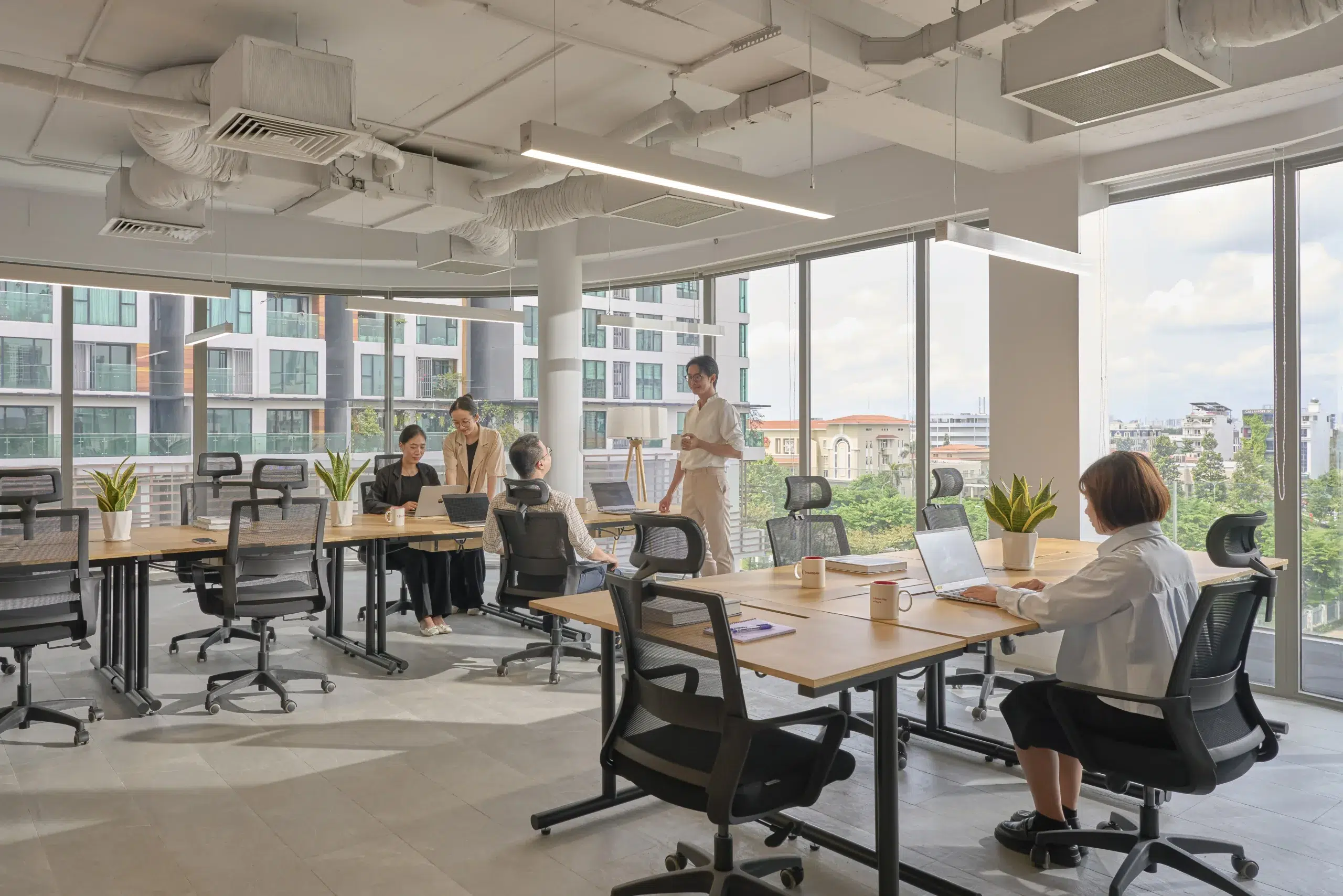
Ready to Settle Your Business for 2026?
- Book a Tour → Experience how Dreamplex helps enterprises reduce cost per employee while enhancing daily performance.
- Join Our Leadership Roundtable → “AI Teams, Human Workplaces: The New Balancing Act.” Learn how Vietnam’s top leaders are designing offices that scale with technology — and still put people first
Dreamplex offers managed private offices, full-floor enterprise solutions, and coworking across six locations in Ho Chi Minh City and Hanoi. Monthly contracts, move-in ready. Contact us for a free consultation and explore special offers this month:
- Hotline: +84 909 90 34 99
- Email: sales@dreamplex.co
Dreamplex – Creating workspace that grows with your business
Private when you need focus. Open when you need energy. Human, always.
We create “A Better Day at Work” that perfectly meets the needs of fast-growing companies that understand that their young employees expect more from their workplace.
Well-designed private, branded offices, 5-star hospitality-level care, and a savvy c help those companies attract, engage, and retain Millennial and GenZ talent in Vietnam.
Dreamplex has 5 locations in Ho Chi Minh City, 1 in Hanoi, and looks to expand further in 2026 to create a better workplace for even more people-centric companies and their employees. Companies like Tiki, AIA, Sky Mavis, Samsung, and more trusted Dreamplex to offer the best office for their teams.

WE CREATE BETTER DAYS AT WORK.
