


Serviced Office for Rent in Vietnam: Why the Model Is Winning in 2026
The serviced office for rent market is no longer driven by startups and freelancers — it is being shaped by multinationals, regional subsidiaries, and growth-stage companies that need private office space without the capital exposure of a traditional lease. Globally, the serviced office market is projected to grow from USD 45.37 billion in 2025 to USD 52.19 billion in 2026, a 15% annual jump. In Vietnam, CBRE reports 12% year-on-year growth in service-integrated workspace models, with flexible spaces running at over 80% occupancy — well above the broader market. For C-level leaders evaluating their Vietnam office strategy, the question is no longer whether a serviced model is viable. It is whether a traditional lease is still worth its risk.
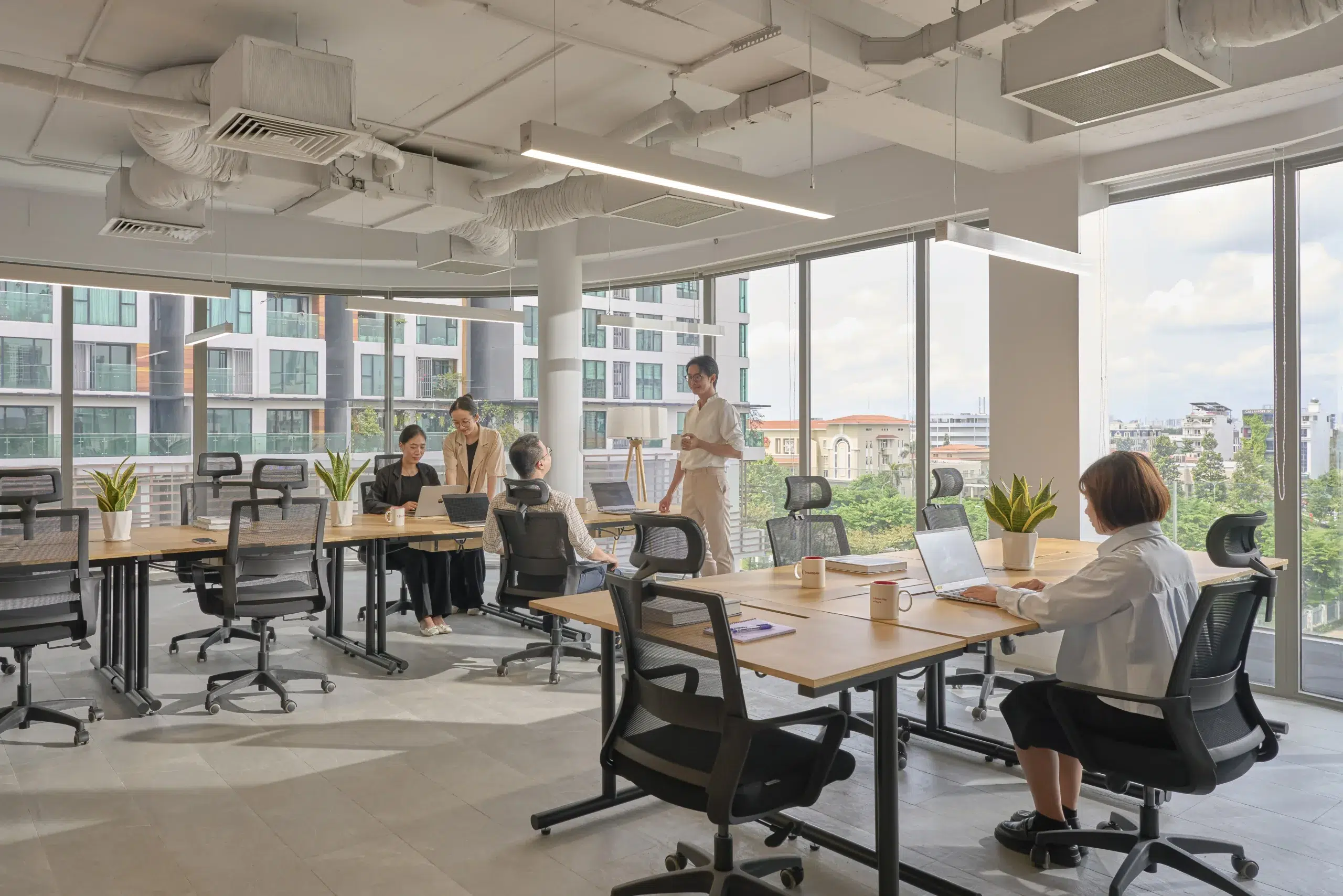
Vietnam’s economy grew 8.02% in 2025 — one of the strongest performances in the region. FDI disbursement hit USD 1.68 billion in January 2026 alone, up 11.3% year-on-year and the strongest January in five years. Foreign companies are entering or expanding in Vietnam at a pace that puts real pressure on one decision in particular: where to put the team, and under what terms.
The answer, for a growing number of organisations, is a serviced office for rent — not as a short-term measure while they sort out a “real” office, but as the deliberate long-term choice.
Why the Traditional Five-Year Lease Has Become a Strategic Liability
For decades, signing a multi-year lease in Ho Chi Minh City or Hanoi was considered a sign of commitment. It signaled stability, seriousness, and a long-term view of the market. Today, the same decision looks different on a balance sheet.
A traditional commercial lease in Vietnam requires two to three months’ deposit, fit-out investment of USD 5–15/sqm (Cushman & Wakefield, Q4 2024), fit-out supervision fees, internet and utilities setup, furniture procurement, and a reinstatement obligation at exit. For a 200 sqm office, the first-year cost of occupancy routinely exceeds the headline rent by 40–60% once all of these variables are included. And all of that capital is committed before a single employee sits down.
In a market where HCMC vacancy rates are forecast to exceed 24% in 2026 and Grade A rents are growing at just 0.4–0.5% (CBRE), locking capital into a five-year fit-out is a bet that the business will look exactly the same — same headcount, same structure, same location needs — for the full duration. Most leadership teams know that bet is difficult to make honestly.
The risk is not the monthly rent. The risk is the inflexibility.
Serviced Office vs Traditional Office Cost: What the Full Picture Looks Like
The price-per-sqm comparison between a serviced office and a traditional lease often makes the traditional option look cheaper. That comparison is misleading, because it excludes most of the real cost.
Cost Category | Traditional Lease | Serviced Office for Rent |
Upfront Investment (CAPEX) | High — deposit, fit-out, AV, furniture | None |
Time to operational | 3–6 months | Days or Weeks |
Monthly cost predictability | Low — utilities, maintenance, repairs variable | High — single fixed invoice |
Included services | None — all managed and paid separately | Reception, IT, cleaning, utilities, meeting rooms |
Flexibility to scale | Low — locked to lease term and sqm | High — expand or contract as needed |
Exit cost | High — reinstatement to bare shell required | None |
Brand / image control | Full — but requires investment to achieve | Premium address and environment provided |
For a company entering Vietnam for the first time, or a regional business opening a second city office, the serviced model eliminates the largest single friction point: the time and capital required before operations can begin. A team that chooses a serviced private office for rent can be fully operational within days of signing. The same team choosing a traditional lease typically waits three to six months.
That gap has a cost. In a fast-moving market, six months of delayed operations is not a neutral outcome.
Enterprise Serviced Office Solutions: No Longer Just for Small Teams
One of the persistent misconceptions about the serviced office market is that it is designed for startups and small teams — and that larger organizations eventually “graduate” to traditional leases.
The data no longer supports that view. JLL’s 2025 Flexible Space Outlook projects that flexible workspace penetration across APAC will rise from 3.5% to 5–6% by 2027, driven largely by enterprise adoption. The shift is structural: companies with 50, 100, or 200 employees are choosing enterprise serviced office solutions precisely because they offer the privacy and control of a traditional lease with the financial flexibility of a service agreement.
What enterprise-grade serviced offices provide today that they did not five years ago is scale without compromise. A company can occupy an entire floor as a private office — branded, secured, configured to their workflow — while still benefiting from the all-inclusive infrastructure, professional reception, and operational support that the serviced model provides. There is no trade-off between the experience of a traditional headquarters and the financial advantages of OPEX-based workspace.
For multinationals establishing Vietnam operations, the all-inclusive office model also solves a governance problem. Regional headquarters increasingly prefer OPEX-based workspace costs because they are predictable, auditable, and do not require the same capital approval process as a fit-out project. A single monthly invoice for a fully operational private office is a significantly simpler conversation with finance than a USD 200,000 fit-out proposal.
What to Evaluate When Choosing a Serviced Office Provider in Vietnam
The serviced office market in Vietnam has grown quickly, and quality varies significantly between providers. The headline price is rarely the right basis for comparison.
Operational consistency: A serviced office is only as good as the team running it. How are maintenance issues handled — is there an on-site team, or does support require an external call-out? What is the response time when something goes wrong with IT or building systems? These questions matter more than the lobby aesthetic.
True all-inclusive pricing: Understand exactly what the monthly fee covers. Does it include electricity, air-conditioning beyond standard hours, meeting room access, and reception services? Or are these billed separately? The difference between a genuinely all-inclusive office and one with an attractive headline rate and a long list of add-ons can be significant over a 12-month period.
Private office integrity: For teams that handle sensitive information — legal, financial, HR — the line between a private office and a shared coworking space needs to be clear and physical. Soundproofing, access control, and dedicated infrastructure matter. Verify these before signing, not after.
Scalability within the same location: If the team grows by 30% in six months, can the space grow with it? The best enterprise serviced office solutions are built around the expectation that clients will scale. Ask specifically whether adjacent space is available and what the process looks like.
Provider stability: Only around 40% of flexible workspace businesses operate profitably. A provider’s occupancy rate, tenure in the market, and financial backing are worth understanding before committing — particularly for teams that cannot afford the disruption of relocating mid-lease.
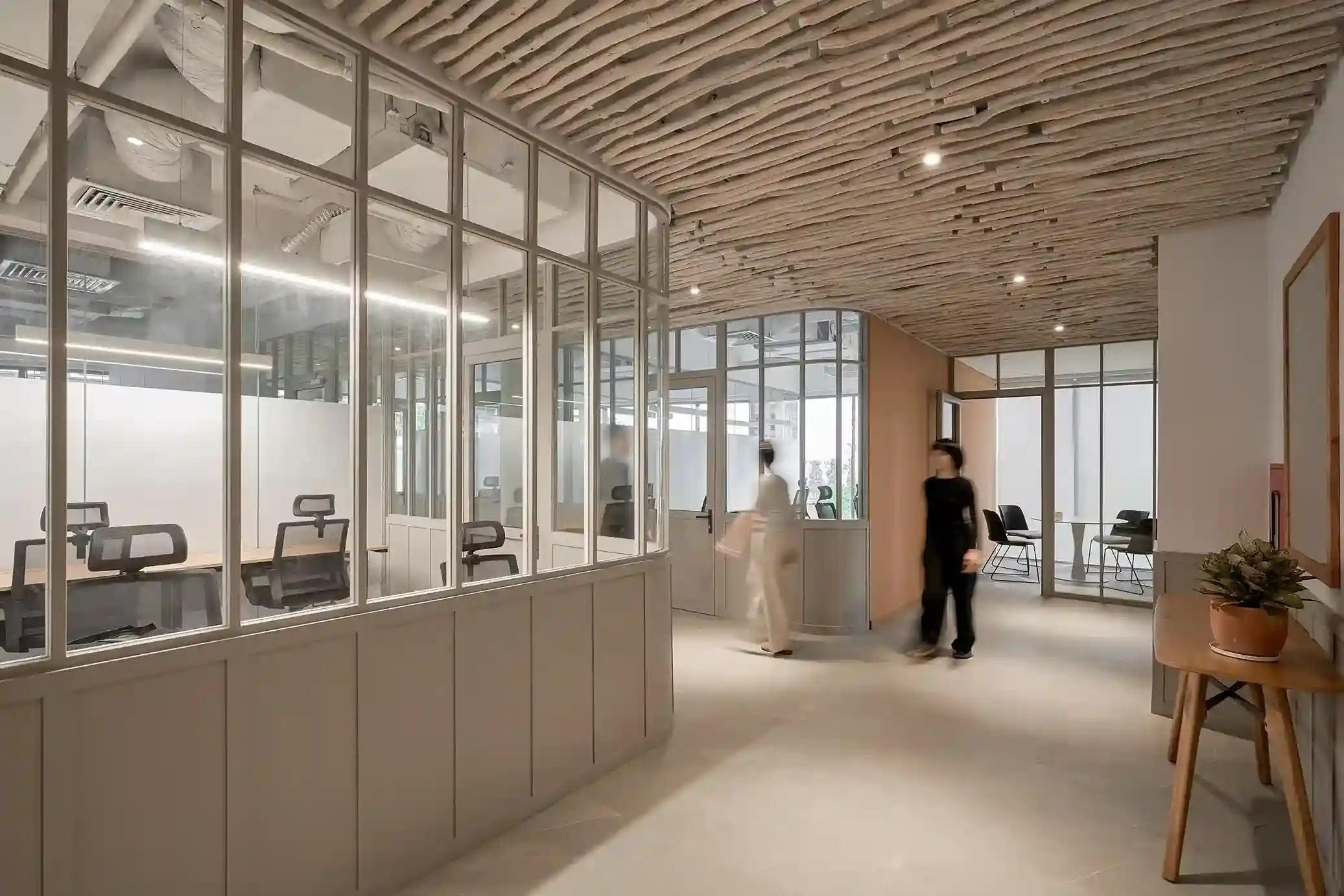
2026 Is the Right Window — But the Window Has a Close
Vietnam’s current office market conditions are unusually favourable for tenants. High vacancy gives negotiating leverage. Flat rents mean there is no urgency to lock in now before prices rise. And the quality of serviced office options at premium addresses has never been higher.
But this window is not permanent. As FDI continues to accelerate — Vietnam absorbed USD 1.68B in disbursed investment in January 2026 alone — demand for well-located, move-in-ready private offices at quality addresses will increase. The spaces that are available today at competitive terms will not all remain available by mid-year.
The advantage goes to the team that moves with clarity rather than speed — knowing precisely what they need, understanding the full cost comparison, and choosing a provider whose operations can genuinely support their growth over the next two to three years.
At Dreamplex, companies find private offices that are ready to move into, professionally managed, and designed to support the kind of work that actually matters — focused, collaborative, and representative of what their brand stands for. The contract is with Dreamplex directly, not the building owner, which removes legal complexity and compresses the timeline from decision to operational.
For leadership teams making their Vietnam workspace decision in 2026, that combination — quality, speed, and financial clarity — is what the right choice looks like.
The Verdict for 2026
The office is not dead. However the era of the passive empty shell is over. Companies today require active environments that contribute to their bottom line and their culture. Whether through all-inclusive office packages that simplify accounting or community-driven spaces that spark collaboration the market is voting with its feet.
For leaders planning their 2026 strategy the choice is clear. You are either in the real estate business managing contractors and air conditioners or you are in your actual business. Providers like Dreamplex have proven that outsourcing the workspace offers more than an office for rent. It provides a platform for growth removing the friction of real estate so that teams focus on what truly matters – their work.
Ready to Scale Your Business for 2026?
- Book a Tour → Experience how Dreamplex helps enterprises reduce cost per employee while enhancing daily performance.
- Join Our Leadership Roundtable → “AI Teams, Human Workplaces: The New Balancing Act.” Learn how Vietnam’s top leaders are designing offices that scale with technology — and still put people first
Contact Dreamplex for a free consultation and explore special offers this month:
- Hotline: +84 706 023 545
- Email: sales@dreamplex.co
Dreamplex – Creating workspace that grows with your business
Private when you need focus. Open when you need energy. Human, always.
We create “A Better Day at Work” that perfectly meets the needs of fast-growing companies that understand that their young employees expect more from their workplace.
Well-designed private, branded offices, 5-star hospitality-level care, and a savvy c help those companies attract, engage, and retain Millennial and GenZ talent in Vietnam.
Dreamplex has 5 locations in Ho Chi Minh City, 1 in Hanoi, and looks to expand further in 2026 to create a better workplace for even more people-centric companies and their employees. Companies like Tiki, AIA, Sky Mavis, Samsung, and more trusted Dreamplex to offer the best office for their teams.
WE CREATE A BETTER DAY AT WORK.

