


Managed Office vs. Traditional Office Lease in Vietnam: An Honest Comparison for 2026
The managed office vs traditional office debate in Vietnam has a clear answer — just not the same answer for every company. Both models can be the right call. The problem is that most companies evaluate them on the wrong variables: headline rent per square meter and total floor area. Run the comparison properly — deposit, fit-out, facilities overhead, flexibility premium, and balance sheet treatment — and the picture looks substantially different. This article does that work.
What you’re actually choosing between
A traditional office lease in Vietnam means signing a contract — typically two to five years — for unfurnished, unmanaged space. You take delivery of a shell, invest in fit-out, hire or contract FM services, manage utilities and IT separately, and return the space to base condition at lease end. You control everything. You pay for everything.
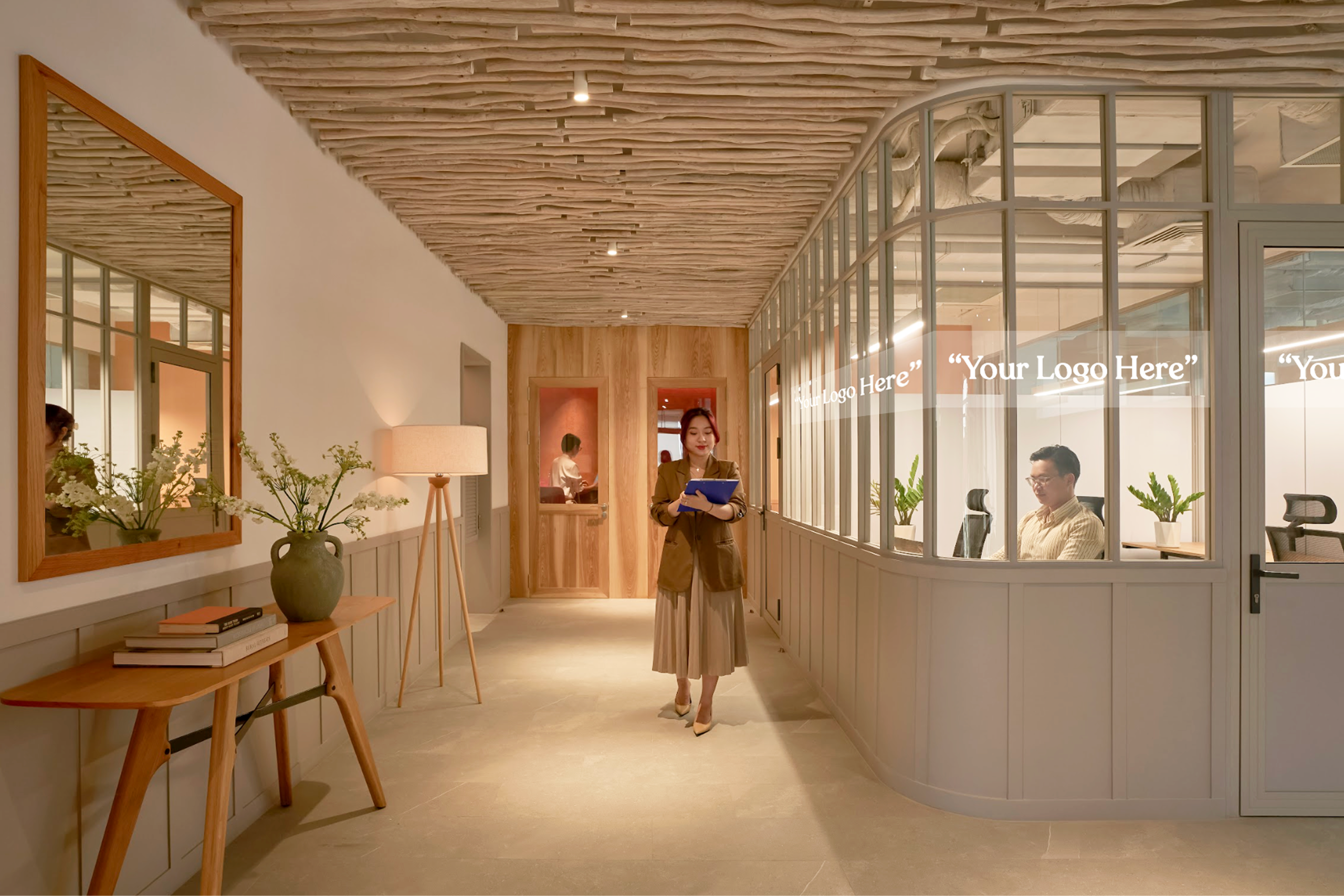
A managed office Vietnam — also called a serviced office or a fully managed office — inverts this model. The operator delivers a furnished, staffed, fully operational space. Your company moves in, works, and pays a single monthly fee. The operator manages all infrastructure below the level of your team’s actual work. You control your operations. The operator controls the building.
The managed office vs traditional office question used to be simpler than it is today. Five years ago, managed offices meant shared coworking environments with hot desks and communal tables — a reasonable option for small teams and startups, but not credible for regional headquarters or enterprise operations. That’s no longer the case.
The enterprise serviced office HCMC market has matured significantly since 2022. Operators now offer full-floor private configurations with custom branding, dedicated IT infrastructure, and 24/7 access — meaning the gap in quality between a managed office and a premium traditional lease has narrowed considerably, while the gap in operational simplicity has widened.
The cost comparison, honestly built
This is where most comparisons go wrong — by comparing monthly rent figures directly, as if that’s the relevant number.
For a team of 25 people occupying 200 sqm in a Grade B District 1 building:
Traditional lease — Year 1 reality:
- Rent: USD 30/sqm → USD 6,000/month
- Service charge: USD 4/sqm → USD 800/month
- Electricity: ~USD 600/month
- Parking (5 cars): ~USD 500/month
- IT and internet: ~USD 200/month
- FM management overhead (ops staff time): ~USD 400/month
- Running monthly total: ~USD 8,500
Upfront capital: deposit (3 months) USD 18,000 + fit-out at USD 200/sqm USD 40,000 + IT setup USD 5,000
- Total upfront: ~USD 63,000
- 3-year TCO: ~USD 369,000
Managed office — same team, same location tier: All-inclusive pricing for 25 desks at a quality operator: USD 180–220/desk/month
- At USD 195/desk: USD 4,875/month
- Upfront: 1–2 months deposit → ~USD 9,750
- 3-year TCO: ~USD 185,250
The traditional lease headline rent is USD 6,000/month. The managed office all-in cost is USD 4,875/month. The hidden costs of office lease Vietnam — service charge, electricity, parking, IT, FM overhead, and fit-out amortized — add USD 2,500/month to the traditional option. Over three years, the managed model costs approximately USD 183,750 less, while requiring USD 53,000 less in upfront capital.
This is the managed office vs traditional office comparison run honestly. The headline numbers point one direction. The full model points somewhere else entirely.
Where traditional leases still win
The numbers above favor managed offices for teams under roughly 50 people. Beyond that threshold, the per-desk economics of traditional leases begin to improve — particularly when fit-out costs are spread across a larger headcount and the company has sufficient operational infrastructure to absorb FM management without meaningful distraction.
Traditional leases make sense when:
Your team size is stable and predictable. The traditional lease model prices in certainty. If you’re confident your team will occupy 300 sqm for three years without significant change, you can optimize for that outcome and capture the lower long-term cost.
You need absolute brand control at scale. For companies where the office is a primary client-facing asset — law firms, financial institutions, regional HQ operations — a purpose-designed traditional lease environment can justify the additional investment. A fully managed office floor HCMC with custom branding addresses this partially, but some enterprises need architectural-level control that only a traditional lease provides.
You have the capital and prefer to deploy it in real estate. Some companies treat office fit-out as an asset and prefer the depreciation treatment over the OPEX line. If your capital position and accounting preferences align with this, a traditional lease on a long-term horizon can offer better financial outcomes.
Where managed offices win — and why the trend is moving in one direction
The CAPEX vs OPEX office Vietnam shift is structural, not cyclical. Every serious managed office vs traditional office analysis in 2026 arrives at the same finding: CBRE’s 2025 data shows 73% of Vietnam-based companies now prioritize flexible lease terms when selecting office space — up from a minority position five years ago. Three forces are driving this.
Speed to market. A traditional lease with fit-out takes four to six months from signing to occupation. A managed office for enterprise HCMC can be ready in days. For companies entering Vietnam, expanding from one city to two, or restructuring team size after a strategic shift, that timeline difference is a competitive variable, not just an operational preference.
Exit optionality. Traditional lease early exits cost three to six months’ remaining rent plus unamortized fit-out. Managed office exits typically require 30 to 60 days’ notice. In a market where business conditions can shift significantly within a single year, that asymmetry has real financial value.
Balance sheet treatment. Under IFRS 16, long-term traditional leases generate right-of-use assets and lease liabilities that affect leverage ratios and EBITDA presentation. A monthly managed office fee runs as an operating expense. For companies managing to external financial covenants or preparing for fundraising, this distinction appears in every board conversation.
The decision framework
Rather than a recommendation that ignores your specific context, here are the conditions that should drive the call:
Choose a managed office if: your team is under 50 people, your growth trajectory is uncertain over a 12–24 month horizon, you’re entering Vietnam or a new city for the first time, your leadership time is better spent on the business than building operations, or your balance sheet treatment of lease obligations is a live constraint. For most regional entries and growth-stage expansions, the managed office vs traditional office decision resolves clearly in favour of managed options at this stage.
Choose a traditional lease if: your team exceeds 50 people with a stable 3–5 year outlook, you have sufficient capital to absorb upfront costs without affecting core operations, you need architectural-level brand control, or your accounting treatment actively favors capital assets over operating expenses.
Consider a hybrid: many mid-sized companies in Vietnam now run a traditional HQ lease for their core team alongside managed office memberships in other locations — giving leadership a permanent address while extending the team’s reach without adding fixed overhead. In this configuration, the managed office vs traditional office dynamic becomes complementary rather than binary.
The managed office vs traditional office decision is ultimately a bet on how well you can predict your next three years. The managed model prices in optionality. The traditional model prices in certainty. Neither is wrong — but only one fits a company that can’t yet see clearly to month 36. In a market moving as quickly as Vietnam in 2026, the value of that optionality is higher than it has been at any point in the past decade.
Ready to Settle Your Business for 2026?
- Book a Tour → Experience how Dreamplex helps enterprises reduce cost per employee while enhancing daily performance.
- Join Our Leadership Roundtable → “AI Teams, Human Workplaces: The New Balancing Act.” Learn how Vietnam’s top leaders are designing offices that scale with technology — and still put people first
Dreamplex offers managed private offices, full-floor enterprise solutions, and coworking across six locations in Ho Chi Minh City and Hanoi. Monthly contracts, move-in ready. Contact us for a free consultation and explore special offers this month:
- Hotline: +84 909 90 34 99
- Email: sales@dreamplex.co
Dreamplex – Creating workspace that grows with your business
Private when you need focus. Open when you need energy. Human, always.
We create “A Better Day at Work” that perfectly meets the needs of fast-growing companies that understand that their young employees expect more from their workplace.
Well-designed private, branded offices, 5-star hospitality-level care, and a savvy c help those companies attract, engage, and retain Millennial and GenZ talent in Vietnam.
Dreamplex has 5 locations in Ho Chi Minh City, 1 in Hanoi, and looks to expand further in 2026 to create a better workplace for even more people-centric companies and their employees. Companies like Tiki, AIA, Sky Mavis, Samsung, and more trusted Dreamplex to offer the best office for their teams.

WE CREATE BETTER DAYS AT WORK.
