


Virtual Office 2026: Policy Shifts and the “Identity” Dilemma for Modern Brands
January 2026 marked a pivotal shift for Vietnam’s business landscape. With the enactment of Resolution 198/2025 – which waives licensing fees for household businesses and SMEs transitioning to enterprise status – the barriers to market entry have never been lower. Yet, as incorporation becomes effortless, a new challenge has crystallized: in a “forest” of new registrations, how does a legitimate business prove it isn’t just another “ghost” company? The answer lies in how we redefine the virtual office.
More Than an Address: The 2026 Business Context
Gone are the days when a virtual office was merely a stopgap for bootstrapped startups. By 2026, it has matured into a calculated financial strategy for Country Managers and established SMEs alike. This evolution is driven by two opposing pressures.
First, legal tightening has intensified. Tax authorities have ceased tolerating “ghost” locations; a registered address must now demonstrate tangible “reachability,” including professional signage and personnel who actually know your company’s name.
Second, the CFO mindset has shifted permanently from CAPEX to OPEX. Amidst global economic fluctuations, locking capital into a 100m² fixed lease is increasingly seen as a liability. Why bury funds in fit-outs when you can project the image of a multinational corporation for less than the cost of a client dinner?
Policy Updates: Opportunity Meets Risk
The arrival of 2026 also activates Circular 99/2025/TT-BTC regarding new accounting standards. This implies that a business address is no longer just a checkbox on a registration form. It requires a provider capable of connecting you with legitimate accounting and tax support from day one.
Checklist 2026: Survival Factors When Choosing a Virtual Office
Selecting the wrong address is now a direct path to the tax authority’s “high-risk” list. Legal experts emphasize three non-negotiable criteria for this year:
1. Physical Presence and “Verify-ability”
Do not be seduced by the cheapest option. Visit the location and ask yourself: If a VIP partner dropped by unannounced, would the receptionist know who I am? A legit virtual office in 2026 goes beyond a brass plaque. It offers receptionists trained to handle calls and guests according to your specific brand script, ensuring that your “virtual” presence feels physically grounded.
2. The Support Ecosystem
“I didn’t just hire an address; I hired an operations team,” explains David Pham, CEO of a tech firm in Ho Chi Minh City. In the current market, a premium virtual address must come attached to a 5-star lobby, standard meeting rooms, and professional mail handling. It is about access to a “business support” ecosystem, not just a mailbox.
3. Scalability
Your business might only need a registration address today, but in six months, you may need desks for three staff members. The strategic move is to select a provider that offers seamless upgrades to a serviced office or coworking space without forcing you to change your business registration – a notorious administrative headache.
The Selection Matrix: Where Do You Fit?
The market has splintered into three distinct segments. Choosing the wrong tier often results in wasted resources or reputational damage.
Criteria | Budget Segment | Standard Segment | Hospitality Segment (Dreamplex) |
Cost (Monthly) | < 500,000 VND | 1,000,000 – 2,000,000 VND | Competitive (high value) |
Location | Grade C buildings, small alleys | Grade B office buildings | Central Grade A/B+ Buildings |
Image & Reception | None or chaotic shared use | Administrative, rigid style | 5-star hotel standard training |
Legal Risk | High (Duplicated/Blacklisted addresses) | Medium | Low (Strict due diligence) |
Experience | None | Basic | "Wow" service, community access |
The Economic Equation: Real Efficiency
The financial argument for the virtual model remains its strongest asset. Data from Q1 2026 highlights the stark contrast in cash flow requirements between maintaining a small traditional office versus a high-end virtual solution coupled with meeting packages.
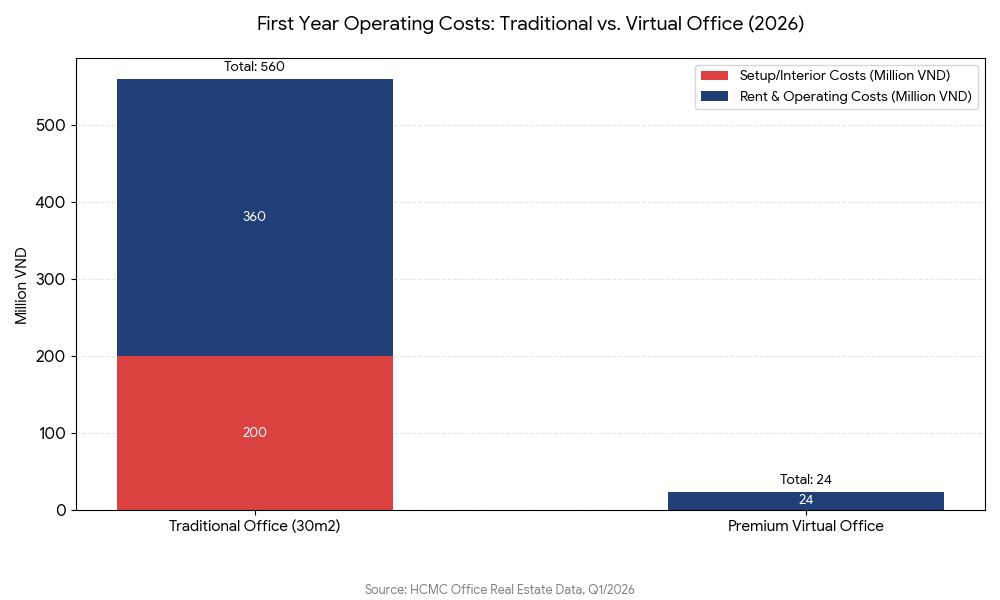
For lean startups and representative offices, “carrying” the setup cost of a traditional space is increasingly difficult to justify.
Dreamplex: When “Virtual” Feels Real
While many providers sell “addresses,” Dreamplex positions itself as a partner in growth, adhering to a “Hospitality-led Workspace” philosophy.
This approach addresses the most significant pain point of the virtual model: the sense of isolation. At Dreamplex, a virtual tenant is still a member of the community. When your partners enter the lobby, they are greeted with the warmth and professionalism of a luxury hotel, offered water, and guided to a lounge that feels like your own headquarters.
For businesses requiring absolute agility, combining a business address with coworking space creates a hybrid model that optimizes costs while maintaining high-performance standards. This is why Dreamplex has emerged as the “right choice” for leaders who demand that their brand image withstand the scrutiny of the market.
People Also Ask about business registration 2026
What are the business registration requirements for 2026?
The process remains digital via the National Business Registration Portal, but verification is stricter. You must provide a notarized lease contract or confirmation from a reputable building management unit to prove the address is not “fictitious” and avoid tax blocking.
How do business tax updates 2026 affect office choice?
Under Resolution 198/2025, SMEs converting from household businesses enjoy license tax exemptions. However, CIT deductibility requires a legitimate address. Virtual office fees remain fully deductible if the provider issues valid VAT invoices and the contract is compliant.
Can I upgrade from a virtual office to a physical one later?
Yes. This is a key advantage of choosing a provider like Dreamplex. You can start with a virtual address for registration and seamlessly upgrade to a private studio or serviced office as your team grows, often without changing your business license address.
Is a virtual office legal for foreign companies in Vietnam?
Yes, provided the location satisfies the physical presence requirements of the Department of Planning and Investment. Using a prestigious provider with a track record of supporting foreign clients significantly smooths the licensing process.
Foreign Market Entry: A Strategic Buffer
Is a virtual office suitable for foreign entities entering Vietnam? Absolutely. It serves as an ideal “market entry strategy,” minimizing initial capital risk. Foreign investors increasingly favor office for rent packages in Grade A buildings to establish immediate credibility when applying for Investment Registration Certificates (IRC/ERC).
Ready to get your business settled and thriving?
- Book a Tour → Experience how Dreamplex helps enterprises reduce cost per employee while enhancing daily performance.
- Join Our Leadership Roundtable → “AI Teams, Human Workplaces: The New Balancing Act.” Learn how Vietnam’s top leaders are designing offices that scale with technology — and still put people first.
Contact Dreamplex for a free consultation and explore special offers:
- Hotline: +84 706 023 545
- Email: sales@dreamplex.co
Dreamplex – Creating workspace that grows with your business
Private when you need focus. Open when you need energy. Human, always.
We create “A Better Day at Work” that perfectly meets the needs of fast-growing companies that understand that their young employees expect more from their workplace.
Well-designed private, branded offices, 5-star hospitality-level care, and a savvy c help those companies attract, engage, and retain Millennial and GenZ talent in Vietnam.
Dreamplex has 5 locations in Ho Chi Minh City, 1 in Hanoi, and looks to expand further in 2026 to create a better workplace for even more people-centric companies and their employees. Companies like Tiki, AIA, Sky Mavis, Samsung, and more trusted Dreamplex to offer the best office for their teams.
WE CREATE A BETTER DAY AT WORK.

