


Coworking Space HCMC in 2026: What the Market Looks Like and When Flexible Is the Right Call
Coworking space HCMC demand in 2026 comes mostly from established companies changing state, not from freelancers. Relocation and expansion drove the majority of large leasing activity in the first half of the year, according to CBRE Vietnam. Grade A supply sits heavily in the central wards, and new completions this year are limited. In that market the negotiable variable is commitment length, not headline rent.
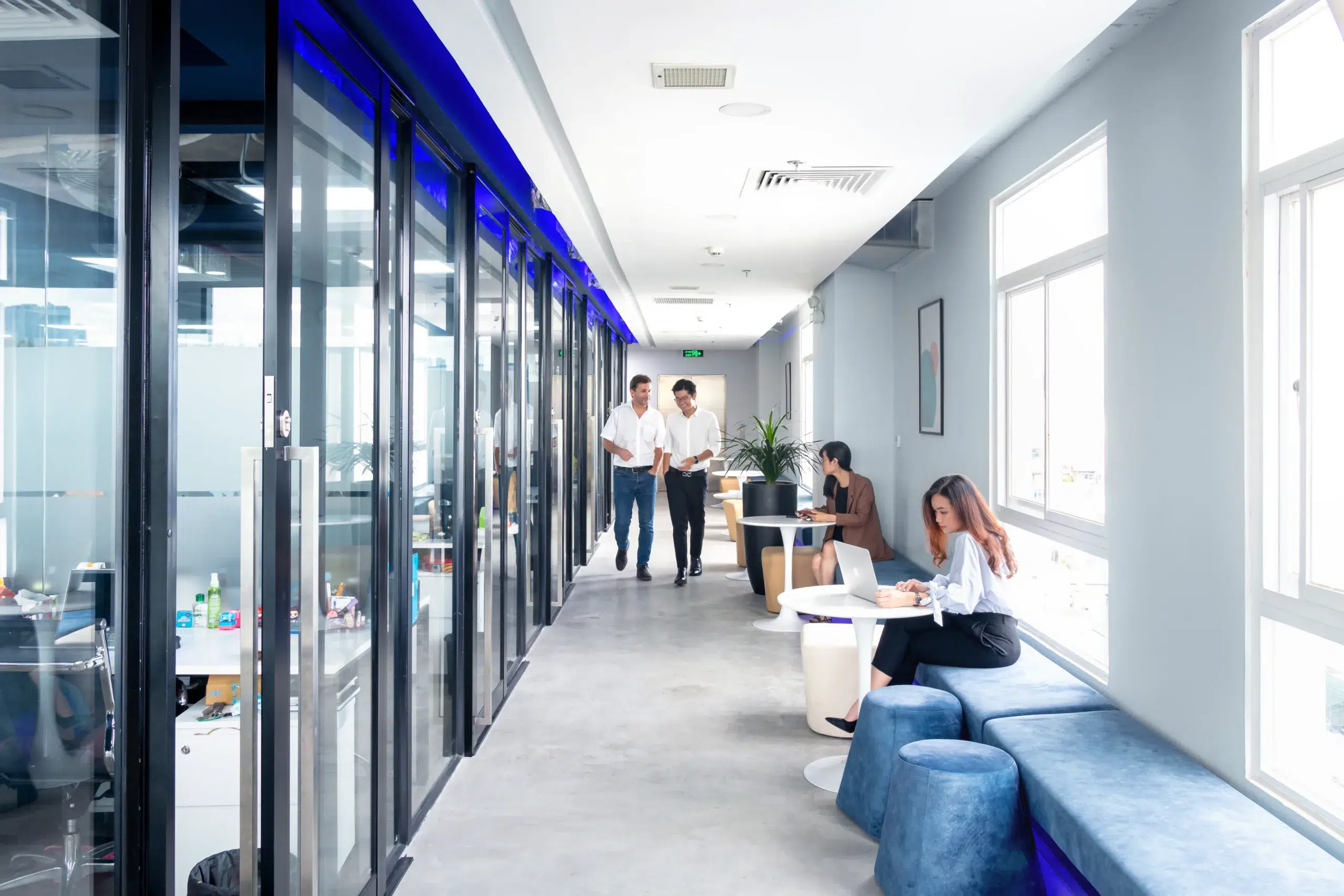
Demand for coworking space HCMC in 2026 is coming from companies that already have an office. Relocation accounted for 39% of large office transaction area in the first half of the year and expansion for 32%, according to CBRE Vietnam. More than 80% of those tenants moved into Grade A or Grade B buildings completed within the past two to three years, on the same CBRE count.
That is a different picture from the one the category still carries. The freelancer at a hot desk is no longer the center of this market.
Coworking space HCMC in 2026: who is actually leasing it
Foreign investment is the pressure behind the demand. Vietnam registered USD 38.05 billion in FDI over the first seven months of 2026, up 58% year on year, according to the Foreign Investment Agency. Ho Chi Minh City took more than USD 3.6 billion of that across 1,235 newly licensed projects, ahead of every other province and city.
Leasing demand in the second quarter came mainly from technology, finance, professional services and FDI-backed companies, according to Avison Young. Central Grade A occupancy reached 92% in the same quarter, according to the same Avison Young report.
But…?
Those tenant groups share a constraint. A regional headquarters or a country office needs a working address on a date set by something else. Usually that date comes from a licensing milestone, a lease expiry or a commitment made to a client. Construction schedules do not bend to any of them.
This is why the search usually starts late. Most companies begin looking after the trigger has already fired, with weeks rather than quarters to work with. A lease signed under that pressure tends to be the wrong size. It reflects the headcount on the signing date rather than the headcount eighteen months afterwards.
The Vietnam International Financial Center in Ho Chi Minh City, which began operating on February 11, 2026, adds another layer of the same demand. Financial institutions and the advisory firms that follow them will search inside a narrow radius of the central wards, where inventory is already tight.
The tier that grew fastest is the private one
The label covers more than it used to. A large share of what operators now sell in Ho Chi Minh City is private and lockable. It goes to teams of ten to a hundred people. The shared floor comes with it as an amenity rather than as the product.
Hot desks and day passes still serve the people who want them. They are no longer where the leasing volume sits.
Keep that distinction in view when comparing quotes. Two providers quoting for coworking space HCMC may be quoting two different products.
Where the central supply sits, and why that decides your options
Grade A office supply in Ho Chi Minh City reached 994,746 sqm in Q2 2026, according to Maison Office. Of that, 748,280 sqm sits in the CBD, according to the same report. Roughly three quarters of the city’s Grade A stock is inside the central wards. Savills Vietnam expects only 7 new projects delivering around 53,684 sqm of leasable office space across the whole of 2026.
Pricing reflects that concentration. JLL put CBD Grade A gross asking rents at USD 64.7 per square meter per month in Q1 2026, up 1.1% year on year. Outside the center, the same JLL figures show USD 36.0, down 0.6%. Ho Chi Minh City ranks among the five most expensive net-rent markets in Asia Pacific, behind Hong Kong, Singapore, Seoul and Tokyo, on JLL’s assessment.
What vacancy numbers show about coworking space HCMC
Vacancy figures read like a tenant’s market and are not one. CBRE recorded Grade A vacancy at 16.7% in Q2 2026 and Grade B at 12.5%. The vacancy concentrates in older buildings and less advantaged locations. Newer, professionally managed buildings continue to hold both their rental levels and their occupancy.
The near-CBD alternative is where the new supply lands
New Grade B supply in Ho Chi Minh City is expected to add around 101,780 sqm, concentrated in non-CBD and near-CBD areas, according to Maison Office. The named projects include OPUSK in Thu Thiem, Metro IX in Thu Duc Ward and a Grade B building in Sai Gon Ward.
That gives companies a genuine alternative. Accommodation outside the center costs materially less per square meter, and the newer buildings compete on floor plate efficiency and management quality rather than on address alone.
The trade-off is client-facing.
A central address still delivers credibility that a less expensive location does not, particularly if Vietnamese banks or state-linked partners visit regularly. Many teams split the two functions. They keep a central base for client contact and put volume headcount where the rate is lower.
For a leader, the practical conclusion is narrow. A good building in the central wards has no reason to discount. The variable still open for negotiation is how long you commit for, and that is the variable flexible operators are built around.
What coworking space HCMC costs against a traditional lease
Most comparisons stop at the rate per square meter. That number is the easiest to measure and the least decisive.
The table below compares the three routes to a working address in central Ho Chi Minh City on the terms a board actually approves.
Decision factor | Traditional Grade A lease | Private office in a flexible center | Coworking desks |
Upfront capital | Design, fit-out, IT, furniture, deposit | None | None |
Time until full operation | Months of construction after signing | 3-5 ngày | Immediate |
Minimum commitment | 3 - 5 years | One month upward | Daily or monthly |
If headcount changes | Renegotiation, subletting or penalty | Move within the same building or network | Add or drop seats |
Where things get locked
Column two is where cash gets locked. A shell floor needs mechanical and electrical work before anyone sits down. Then come cabling and partitions, then lighting and furniture, then the IT build. All of it lands on the balance sheet as a fast-depreciating asset that produces no revenue.
Columns three and four convert that into a monthly operating cost. For a CFO planning a year in which growth still depends on client disbursement timing, one predictable invoice carries its own weight in the plan.
One caveat belongs with the comparison. A flexible rate quoted per workstation and a lease rate quoted per square meter are not directly comparable. The flexible figure already absorbs circulation space, meeting rooms, pantry and reception, all of which a leased floor charges for separately
Convert both to a cost per seat per month before the numbers reach a board paper. Our 2026 Vietnam office market forecast works through the capital side of that argument in more detail.
When coworking space HCMC is the wrong answer
Workspace operators rarely publish this section. Leadership teams should read it anyway.
A company with a stable headcount, surplus liquidity and a definite five-year plan will pay considerably less per seat on a traditional lease. Operations that need technical floors, laboratories, secure storage or dedicated physical access control will not fit a flexible arrangement. Some regulated sectors carry on-premise data requirements that rule it out entirely.
Scale matters too. Past a few hundred seats, most companies already employ the admin team that a flexible operator’s service layer replaces. At that point part of the monthly fee buys capability the business owns twice. The threshold differs by company, and it deserves a calculation rather than an instinct.
The real line runs through certainty. A company that knows its headcount three years out should sign long. A company that does not is paying for a forecast, and the price of a wrong forecast inside a traditional lease is the deposit, the penalty and the cost of reinstating the floor.
The decision to make before your current lease renews
The setup for the rest of 2026 is clear enough. Capital is arriving quickly while quality supply arrives slowly, central rents are holding, and most large transactions come from companies that are already in the market and on the move.
Against that backdrop, the argument for flexible workspace is not that it costs less. It keeps a decision open while still putting the team at the address the business needs.
One thing to check while comparing coworking space HCMC providers is what the quoted rate actually includes. Electricity above a usage cap, meeting room hours, after-hours air conditioning and visitor handling are billed differently by different operators. Ask for a sample invoice from a current member rather than a rate card.
Three questions to settle first
Answer these while your current lease still has six months to run.
How far will headcount move over the next 18 months, and how confident are you in that number? If a move became urgent next quarter, how many weeks would it take? What would it cost? And does the capital earmarked for fit-out have a better use elsewhere?
Answer these while your current lease still has six months to run.
How far will headcount move over the next 18 months, and how confident are you in that number? If a move became urgent next quarter, how many weeks would it take? What would it cost? And does the capital earmarked for fit-out have a better use elsewhere?
Dreamplex runs five locations in Ho Chi Minh City and one in Hanoi. The range covers coworking and dedicated desks through to private serviced offices for teams of 2 to 150. Terms start at one month and arrive as one monthly invoice.
Dreamplex Tran Quang Khai residents the Tan Dinh are, neighboring Binh Thanh, Phu Nhuan without the traffic bottlenecks. Dreamplex Private Tran Quoc Toan has the most executive vibe with private whole floors and dedicated lift access, for teams arriving at 30 people or more. Dreamplex Ngo Quang Huy and Dreamplex Le Hien Mai both won VMARK Design Award, offering unique vibes that gracefully marry boutique aesthetics with productivity and work experience.
The Member Experience team handles reception and facilities, along with the connectivity issues that eat an admin manager’s week. That keeps the administrative load away from your leadership.
The right coworking space HCMC option is rarely the cheapest one on the list, and rarely the largest. It is the one that lets the team work from week one and lets the company change its mind at a sensible cost.
Ready to Scale Your Business for 2026?
- Book a Tour → Experience how Dreamplex helps enterprises reduce cost per employee while enhancing daily performance.
- Join Our Leadership Roundtable → “AI Teams, Human Workplaces: The New Balancing Act.” Learn how Vietnam’s top leaders are designing offices that scale with technology — and still put people first
Contact Dreamplex for a free consultation and explore special offers this month:
- Hotline: +84 909 90 34 99
- Email: sales@dreamplex.co
Dreamplex – Creating workspace that grows with your business
Private when you need focus. Open when you need energy. Human, always.
We create “A Better Day at Work” that perfectly meets the needs of fast-growing companies that understand that their young employees expect more from their workplace.
Well-designed private, branded offices, 5-star hospitality-level care, and a savvy c help those companies attract, engage, and retain Millennial and GenZ talent in Vietnam.
Dreamplex has 5 locations in Ho Chi Minh City, 1 in Hanoi, and looks to expand further in 2026 to create a better workplace for even more people-centric companies and their employees. Companies like Tiki, AIA, Sky Mavis, Samsung, and more trusted Dreamplex to offer the best office for their teams.
WE CREATE A BETTER DAY AT WORK.
